The Impact of Russia's Fuel Supply Challenges on Reshaping Import and Export Trade: The Market Insights, and the Future Business Outlook
- Jul 02, 2026
The Impact of Russia's Fuel Supply Challenges on Reshaping Import and Export Trade: The Market Insights, and the Future Business Outlook
Russia is popular as one of the largest energy producers while maintaining its thriving role in the international trade of crude oil, natural gas, refined petroleum products, and petrochemicals. The vast hydrocarbon reserves present in the nation have made the country a top-tier supplier of mineral fuels to Europe, Asia, the Middle East, and several emerging economies.
The recent fuel supply challenges, including geopolitical developments, sanctions, logistical disruptions, and refinery maintenance, have affected the overall trade. Russia Import Data reported the fuel trade as the new turnover of the supply chain diversification. The strategic partnerships and the domestic energy security have maintained the priorities of Russia's trade over the specific category.
The Russia Import Export Trade Data is right now considered one of the essential business intelligence tools because the commodity traders, energy companies, logistics providers, and procurement agencies are monitoring the changing shipment trends. The identification of the new buyers and suppliers is promoting the evaluation of pricing movements and understanding of the emerging global trade opportunities. The businesses referring to the shipment-level Russia Trade Data can gain actual trade insights into exporter and importer activities to understand the transportation modes and trade frequencies. Subscribe to Import Globals to stay updated with the latest activities of Russia's fuel supply challenges via the Russia trade data.
The Exclusive Overview of Russia's Changing Fuel Trade
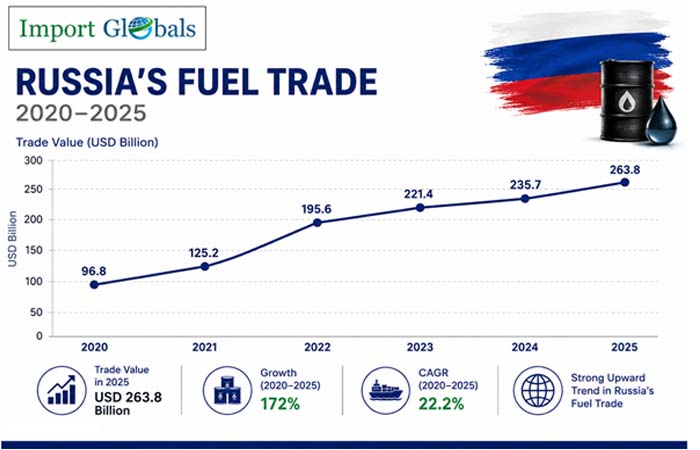
Russia has been one of the largest exporters of crude petroleum, natural gas, refined fuels, coal, fertilizers, and petroleum derivatives. The geopolitical developments have maintained the successful redirection of the significant fuel exports toward Asia, the Middle East, Africa, and Latin America.
The merchandise trade has maintained the strong exportability of the nation with partnerships from China, India, Turkey, Southeast Asia, and several other developing economies. The increased imports of Russia's specialized industrial equipment, refining technologies, and automotive components have reshaped the import and export strategies says Russia Shipments Data.
Why Are Russia's Fuel Supply Challenges Having an Impact on Global Trade?
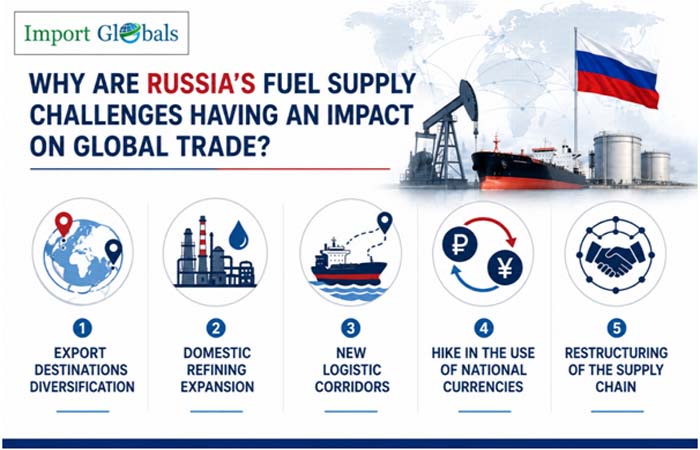
The fuel supply challenges of Russia have a great impact on global trade in different important ways. Below are the factors that represent why the fuel supply challenges of the country are reshaping global trade.
1. Export Destinations Diversification - The decline in the European Union demand rate has expanded the export of the Russian authorities to Asian economies, particularly India and China. The geographical shift in the trade route has led to a change in the global tanker road shipping demand and the pricing structures.
2. Domestic Refining Expansion - The accelerated investment made by the government authorities of Russia in refinery modernization has improved the fuel quality. It has overall expanded the exports of higher-value petroleum products.
3. New Logistic Corridors - The alternative shipping routes have mainly increased the important trade for maintaining uninterrupted fuel exports. The shipping routes fluctuate through Arctic ports, and the Caspian region and has maintained an effective trade supply.
4. Hike in the use of National Currencies - The use of national currencies for overseas trade has reduced the reliance on traditional payment systems. It has led to a strengthening of bilateral trade relationships with the nearby regions.
5. Restructuring of the Supply Chain - The international buyer activities are overall diversifying the customer portfolios. It has even created an increasingly competitive global energy marketplace for the trade forum.
The Comprehensive Role of Russia Import-Export Data in Promoting Business Decisions
The shipment-level trade intelligence on Russia's overall exports is considered a valuable tool for the business authorities trying to stay progressive. The businesses operating in the energy sector can expand their businesses with the latest datasets highlighted, including exporter name, importer name, buyer details, supplier information, product description, HS code, shipment quantity, unit price, shipment value, origin country, destination country, port of loading, port of discharge, transportation mode, and shipment date.
The valuable insights regarding the specific information help businesses evaluate the supplier's reliability. It even promotes the monitoring of competitor activities with identification of emerging markets and pinpointing the pricing strategies with proper improvement in the international sourcing decisions.
The Major Import Partners Supporting Russia's Fuel Industry
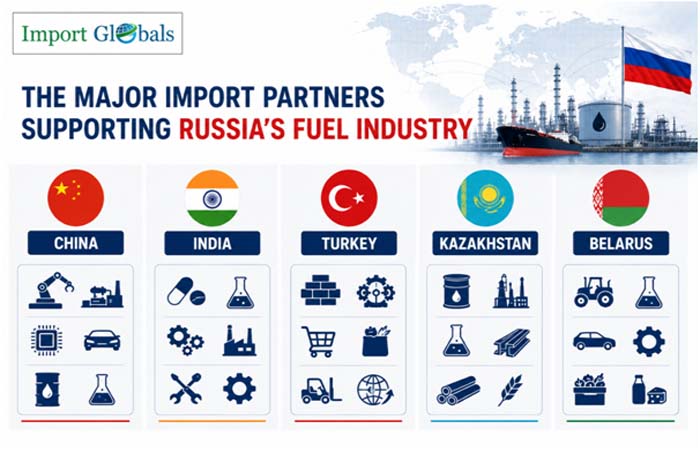
The continuous import of strategic industrial products has maintained the trade landscape of the region. As per the Russia Shipment Trade Data, the top trade partners benefiting the fuel industry of the nation in 2025 are,
1. China - China is considered one of the top suppliers of industrial machinery, manufacturing equipment, electronics, and automotive parts. China Export Data reported the energy components and industrial chemicals as the main factors supporting the Russian manufacturing and refinery operations.
2. India - India is responsible for the export of pharmaceuticals, specialty chemicals, industrial machinery, and engineering goods. The trade of manufacturing inputs as per the Russian-demanded categories has maintained the bilateral relationships of both regions.
3. Turkey - Turkey Export Data reported construction materials, machinery, consumer goods, food products, and industrial equipment as the main traded categories within the economy. The trade of the specific commodity has made Turkey an important logistics and re-export hub.
4. Kazakhstan - Kazakhstan Export Data reported the nation as one of the regional traders of Russia's fuel industry essentials. Trade in petroleum products, industrial materials, chemicals, metals, and agricultural commodities has promoted cross-border logistics cooperation.
5. Belarus - Belarus Export Data reported agricultural equipment, chemicals, automotive components, and food products as the top traded categories between Belarus and Russia.
The Leading Export Destinations Facilitating Russia's Fuel Trade
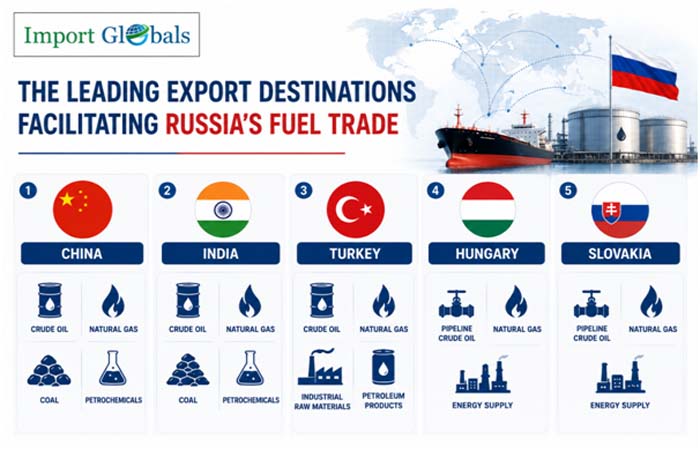
The continuous supply of energy products from Russia has had a greater impact on the global trade portfolio. As represented by the Russia Export Data, the top trade partners crafting the fuel oil export of the nation in 2025 are,
1. China - China Import Data reported the trade of crude oil, natural gas, coal, and petrochemicals as the main factors maintaining the bilateral integrity within both economies.
2. India - India is also a significant importer of Russian crude oil. The increasing demand in the nation for energy essentials has promoted the bilateral relationship with the Russian authorities.
3. Turkey - The imports of crude petroleum and natural gas are listed by the Turkey Import Data as the top resource essentials from the Russian authorities. The industrial raw materials also have a greater impact on the bilateral relationship of both economies.
4. Hungary - Hungary is a continuous importer of pipeline crude oil and natural gas, as represented by the Hungary Import Data. The domestic energy requirements are supported by the specific traded categories.
5. Slovakia - Energy imports are a significant contributor to Slovakia's import of energy essentials from Russia, as reported by the Slovakia Import Data.
Topmost Industries Affected by Russia's Fuel Supply Challenges
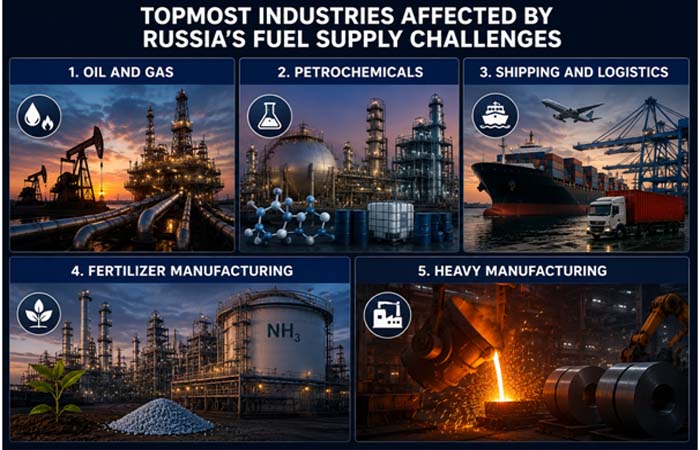
1. Oil and Gas - The oil and gas industry is considered one of the top sectors affected by the fuel supply challenges of Russian authorities. The production scheduling, refinery utilization, shipping logistics, and export destination diversification are some of the recent fluctuations that have occurred in the oil and gas industry due to the fuel supply challenges.
2. Petrochemicals - The fuel supply challenges faced by the Russian authorities have resulted in a change in the feedstock availability and export routes. It has influenced petrochemical manufacturing on a global scale while affecting international distribution.
3. Shipping and Logistics - The challenges faced by the Russian authorities over the fuel oil trade have disrupted the effective functioning of the shipping and logistics industry. Russia Customs Data says that it has increased the freight demand while creating opportunities for alternative shipping companies.
4. Fertilizer Manufacturing - The fluctuations in the fuel oil trade from Russia have impacted the fertilizer manufacturing industry. The natural gas availability has influenced fertilizer production while making the industry closely connected with the fuel supply conditions.
5. Heavy Manufacturing - Heavy manufacturing is also a significant impact region of the fuel supply challenges of Russia. Steel, cement, mining, and industrial manufacturing are getting impacted due to the competitive energy prices.
The Latest Business Opportunities Created by the Changing Fuel Trade
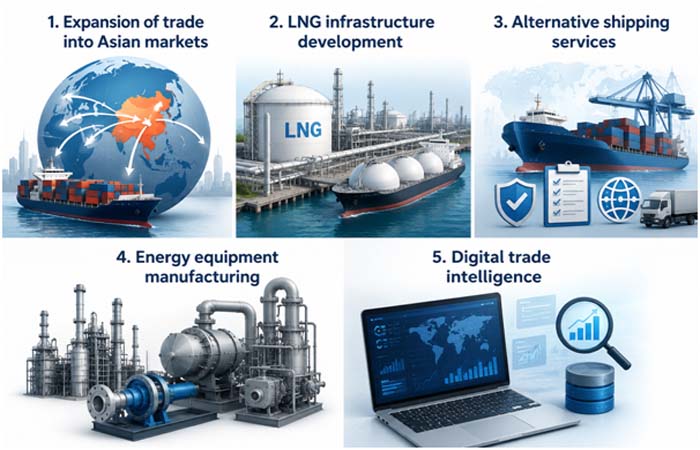
1. Expansion of Trade into Asian Markets - Global Trade Data reported the growing energy demand across Asia as one of the significant opportunities created by the change in the fuel trade. The shipping companies, commodity traders, and infrastructure investors are recognizing a significant increase in their overall trade.
2. LNG Infrastructure Development - The investments made by the government authorities of different regions in liquefied natural gas terminals, storage facilities and export infrastructure have probably expanded the long-term trade opportunities. It has overall boosted the liquefaction of trade as per the demanded categories.
3. Alternative Shipping Services – Russia Trade Data says that the specialization of different authorities in marine logistics, insurance, freight forwarding, and port operations has benefited the evolution of the trade routes. The companies trying to expand can acknowledge the latest trade activities to stay competitive.
4. Energy Equipment Manufacturing - The increase in demand for refinery equipment, industrial machinery, and storage systems has promoted the pipeline infrastructure. It has overall boosted the trade integrity as per the growing demand rates.
5. Digital Trade Intelligence - Wrapping up the list of the opportunities created by the changing fuel trade, digital trade intelligence is also a significant one. The businesses can now rely on the shipment-level trade databases for active recovery and identification of buyers, suppliers, and pricing trends.
How Does Russia's Trade Data Support International Business?
Russia Shipments Data on Import Globals is considered beneficial for the business authorities to stay progressive because it helps the authorities identify the verified importers and exporters. The analysis of the shipment frequencies and the evaluation of the pricing movements helps businesses pinpoint the competitors' activities over specific niches. It even promotes the optimization of the demand rates while reducing the sourcing risk.
The expansion into high-growth international markets further aids the specific trade strategies. The manufacturers are now able to identify the reliable overseas buyers with a proper understanding of the supplier performance. The business authorities can even establish their long-term commercial partnerships in order to stay competitive amidst the hike in global trade. The commodity traders can monitor the changes in export destinations and the seasonal demand to improve their trading decisions.
The Significant Challenges Impacting the Import and Export Trade of Russia's Fuel
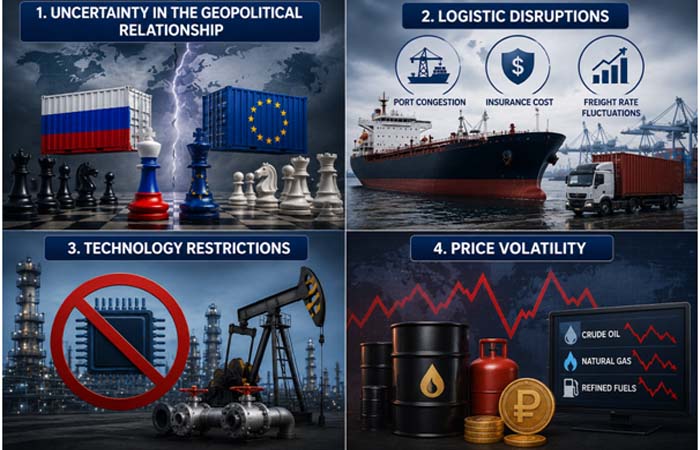
1. Uncertainty in the Geopolitical Relationship - The sudden changes in international policy have maintained their influence on trade relationships of Russian authorities with the nearby regions, as represented by the Russia Import Customs Data. The investment decisions and commercial operations are impacting Russia's fuel oil trade.
2. Logistic Disruptions - The port congestion, insurance cost, and freight rate fluctuations are impacting the trade of fuel oil from the Russian authorities. The longer shipping routes are mainly involved in the regulation of trade.
3. Technology Restrictions - The reliable access to certain advanced industrial technologies is considered the main factor promoting the alternative sourcing strategies fuelling Russia's mineral fuels and fuel oil trade.
4. Price Volatility - The investments made by the government authorities in global fluctuations regarding the trade of crude oil, natural gas, and refined fuels have created uncertainty for the exporters and buyers. The price volatility has impacted the Russian import and export of fuel oils to maintain the competitiveness of the overall region.
Future Trade Outlook of Russia's Fuel, Import and Export Trade
The fuel oil trade of Russia will be driving the export economic growth rate of the nation in the near future. The investment made by the government authorities in domestic refining and LNG production, as well as the shipping routes and energy infrastructure, will solidify the image of the country as a reliable trader. Export diversification will strengthen long-term trade competitiveness. The Asian economies will maintain a stronger trade relationship with the latest investing regions.
The increase in industrialization across developing countries will support the demand for crude oil, natural gas, fertilizers, and petroleum products. The expansion of digital trade will further help businesses monitor the market demand with the proper identification of verified buyers and suppliers. It will even promote optimization of international sources while significantly reducing the commercial risks.
Conclusion
The fuel supply challenges of Russia are a significant result of the increasing evolution of the country's fuel oil trade. The encouragement of the supply chain diversification, alternative logistic networks, and expanded refining capacity is mainly because of the stronger partnerships with the emerging markets. The geopolitical developments altering the traditional trade patterns are mainly because of the country's positioning as one of the largest energy exporters.
The investment made by the government authorities in refining, LNG infrastructure, transportation corridors, and industrial modernization will strengthen the long-term export competitiveness of the nation. The shipment level trade intelligence is on the way to understanding the buyer behaviour with proper acknowledgement of the competitor activities, identification of profitable markets, and development of effective global expansion strategies. The global energy markets will continue to evolve in collaboration with import-export trade activities, supported by the Russia Trade Data.
CTA
Looking for an expansion in your international business through Russia's evolving commodity trade, you have landed at the right platform here. Import Globals is responsible for resolving all your complexities of trade with verified trade intelligence. Subscribe to www.importglobals.com or email info@importglobals.com to accelerate your global business growth with the latest trade insights on Russia's fuel oil challenges.
FAQs
Que. Why are Russia's fuel supply challenges having a significant impact on global trade?
Ans. The changes in the energy supply influence the crude oil prices, refining operations, and logistic networks, overall affecting the global trade.
Que. Name the largest buyers of Russian fuel exports.
Ans. China, India, Turkey, Hungary are some of the largest importers of Russian fuel exports.
Que. Name the top dominating categories of Russia's fuel exports.
Ans. Crude oil, natural gas, LNG, and refined petroleum products are the top traded fuel exports of the Russian Federation.
Que. How does Russia Trade Data help businesses?
Ans. Russia Trade Data helps businesses via proper identification of buyers, suppliers, analysis of market demand, and development of effective market expansion strategies.
Que. Which industries benefit most from the Russia Export Trade Data?
Ans. Energy, petrochemicals, logistics, and commodity trading benefit the most from the Russia Export Trade Data.
Que. List the major challenges associated with Russia's fuel trade.
Ans. Geopolitical uncertainty, logistic disruptions, and technology restrictions are the major challenges associated with Russia's fuel trade.
Que. What opportunities are linked with Russia's changing fuel trade?
Ans. The LNG infrastructure, refinery modernization, and Asian market expansion are linked with Russia's changing fuel trade.
Que. How frequently is Russia Shipment Data updated?
Ans. Russia Shipment Data is updated on a monthly basis.
Que. What information does Russia Fuel Shipment Data cover?
Ans. Russia Fel Shipment Data covers Importer names, Exporter names, Shipment date, HS Code, Product Details, quantity, values, pricing information, origin country, importing country & port details.
Que. Where to get detailed information on Russia Duel Trade Data?
Ans. Visit www.importglobals.com or email at info@importglobals.com for detailed updates on Russia Fuel Trade Data.
You Can Also Visit :-
Information About Russia's Oil Exports, Such as How Much Oil Russia Makes and WHO Sells It
Russian Oil Exports in 2025: Navigating Sanctions and Sustaining Trade
What does Russia's 40% Discount on LNG mean for The Global Gas Market and India's Energy Security?